Child Panels vs Regular SMM Panels: What’s the Difference?
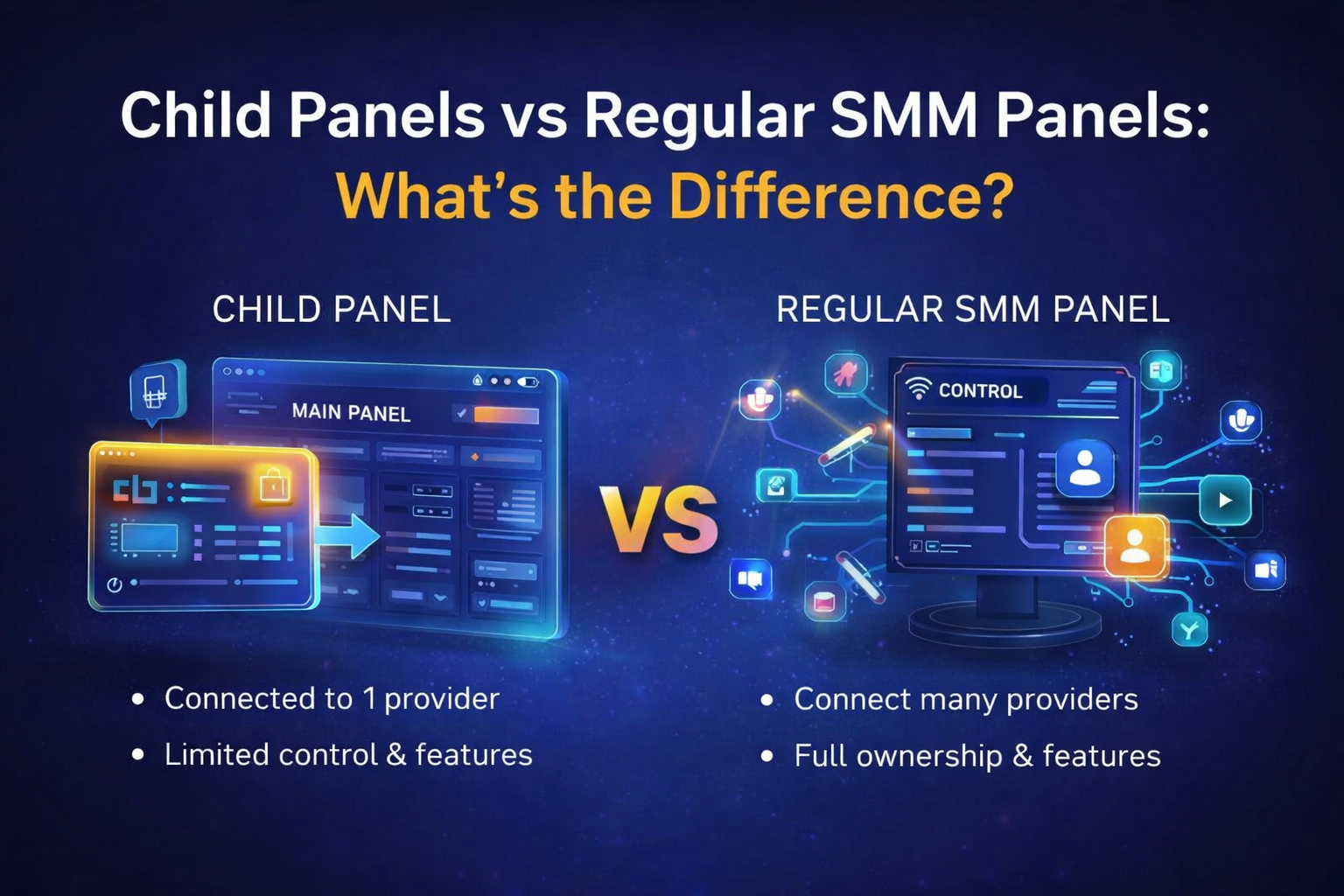
What Are Child Panels and How Do They Differ From Regular SMM Panels?
When entering the SMM panel business, one of the first decisions you’ll encounter is choosing between a regular SMM panel and a child panel. While both options allow you to sell social media services, they operate very differently in terms of control, flexibility, and scalability.
Understanding these differences is essential if you want to build a sustainable SMM panel business.
What Is a Child Panel?
A child panel is a simplified SMM panel that is connected to a larger main panel (the provider). Instead of managing providers and services independently, the child panel relies entirely on the main panel for order processing and service delivery.
Because of this structure, child panels are often used by beginners who want to start reselling SMM services without managing the technical side of the business.
What Is a Regular SMM Panel?
A regular panel is a fully independent SMM panel. The owner has complete control over providers, services, pricing, automation tools, and integrations.
Unlike child panels, regular panels allow admins to connect multiple service providers, automate workflows, and scale the platform without depending on another panel.
Key Differences Between Child Panels and Regular Panels
The table below highlights some of the most important differences between a regular SMM panel and a child panel.
| Feature | Regular Panel | Child Panel |
|---|---|---|
| Child Panels Selling | ✓ | ✗ |
| Admin API | ✓ | ✗ |
| Average Time | ✓ | ✗ |
| Affiliate System | ✓ | ✗ |
| Updates Page | ✓ | ✗ |
| Multi-Currency Module | ✓ | ✗ |
1. Ownership and Control
The biggest difference between these two panel types is ownership. With a regular panel, the owner has full administrative control over the entire platform.
In contrast, a child panel is always connected to a parent panel. This means the parent panel owner still has access to system-level controls and manages the core infrastructure.
2. Service Providers
Regular panels allow administrators to connect multiple providers through APIs. This flexibility helps panel owners diversify services and improve reliability.
Child panels, however, typically depend on a single provider — the parent panel they are linked to.
3. Features and Customization
Regular panels usually include advanced features such as automation tools, API integrations, affiliate systems, and multiple provider connections.
Child panels often have limited access to these features because they operate as an extension of the main panel.
4. Cost and Accessibility
Child panels are typically cheaper to run because they rely on the infrastructure of the parent panel. This makes them attractive for new resellers who want to start selling SMM services with minimal cost.
Regular panels, on the other hand, cost more to maintain but provide significantly more control and long-term growth potential.
When Should You Use a Child Panel?
- New resellers entering the SMM industry
- Users who want a low-cost way to test the market
- Businesses that don’t need full control over providers
They provide a quick way to start selling SMM services without managing complex infrastructure.
When Is a Regular Panel the Better Choice?
If your goal is to build a scalable SMM platform and manage providers independently, a regular panel is the better long-term solution.
It allows you to automate operations, integrate multiple APIs, and customize the platform according to your business needs.
Final Thoughts
Both child panels and regular panels serve a purpose in the SMM ecosystem. Child panels offer an accessible entry point for beginners, while regular panels provide the flexibility and control required for serious businesses.
If you’re planning to scale your SMM panel and build a professional platform, investing in a regular panel with automation and API integrations will give you the best long-term results.